Fotona 4D Laser Facelift: What to Expect
A 'facelift' with no scalpel and no downtime? Here's an honest look at what the Fotona 4D laser actually does — its four modes, what it feels like, sessions, results and how it compares to a CO₂ laser.
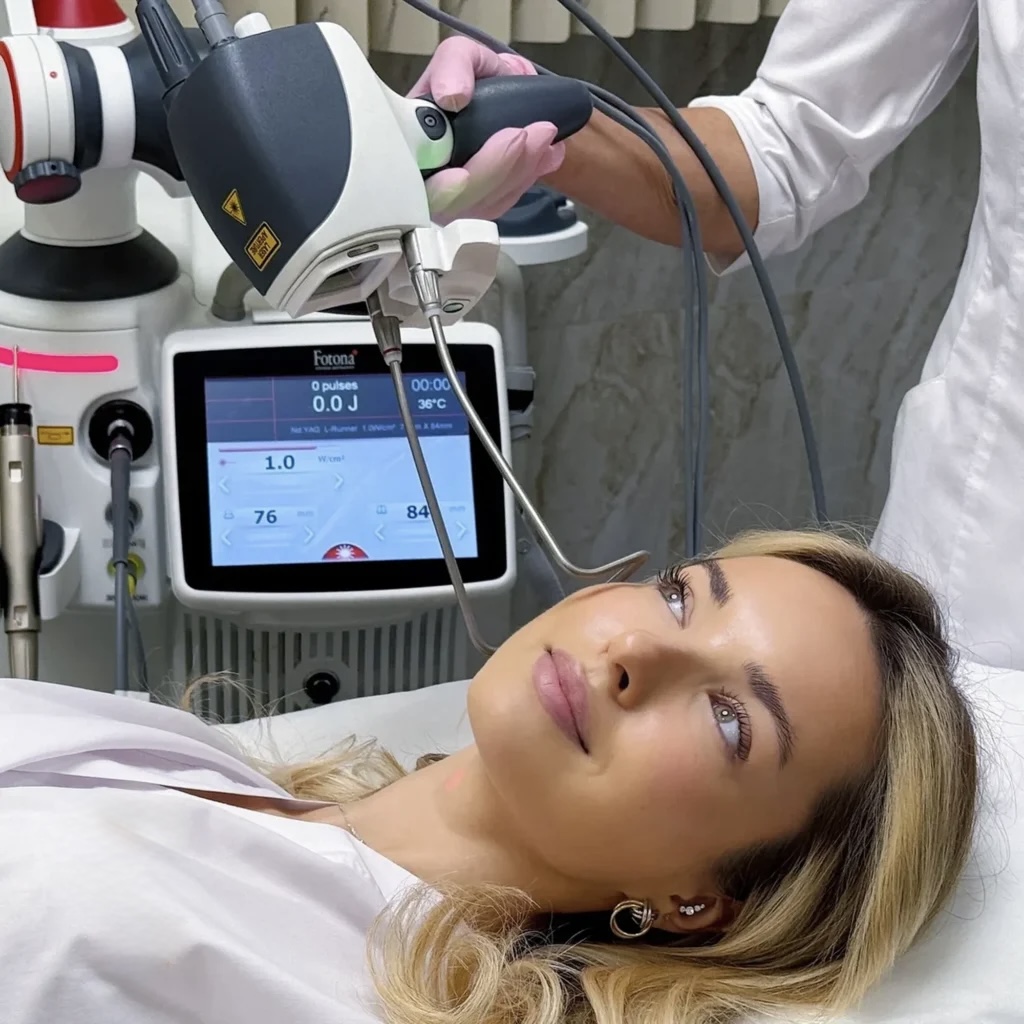
- Fotona 4D is a non-surgical laser 'facelift' using four modes across two wavelengths — including an intraoral step that tightens from inside the mouth.
- It builds collagen and tightens from multiple angles with minimal to no downtime, unlike an ablative CO₂ laser.
- Most patients need three to four sessions; results build gradually over weeks as new collagen forms.
- Fotona 4D starts from $1,200 per session, with a 3-session course at $3,200.
A 'facelift' without a scalpel sounds too good to be true — but that's essentially what the Fotona 4D laser is designed to deliver. It's a non-surgical laser treatment that tightens and rejuvenates the face from multiple angles at once, using four distinct treatment modes across two laser wavelengths. What makes it genuinely different from a lot of laser treatments is that one of those modes works inside your mouth, tightening the deep tissue that supports your lower face and folds — an angle no surface laser can reach. This guide walks through exactly what to expect from a Fotona 4D non-surgical facelift: the four steps, what it feels like, how many sessions you'll need, the results timeline, how it compares to a CO₂ laser, and who it suits.
The headline benefit is that Fotona 4D achieves meaningful tightening with minimal to no downtime, because it's primarily non-ablative — it heats and stimulates the tissue without stripping away the skin's surface the way an aggressive resurfacing laser does. You get the collagen-building and tightening without the week of peeling.
The four steps, in plain English
Fotona 4D's name comes from its four sequential modes, each targeting a different layer or angle:
1. SmoothLiftin (the intraoral step). This is the signature move. The laser is applied *inside the mouth*, gently heating the tissue of the cheeks and around the mouth from the inside out. This tightens the deep folds — the nasolabial lines and the area around the lips — from a direction no surface treatment can access. 2. FRAC3. Working now on the outside of the skin, this mode targets deeper imperfections and sun damage in a fractional pattern, addressing pigment and stimulating collagen where it's needed most. 3. PIANO. A gentle bulk-heating mode that warms the deeper layers broadly and comfortably, driving the tightening and lifting effect across the whole face. 4. SupErficial. A final light, superficial peel-like pass that refines the very top layer of skin for a smooth, glowing finish.
Together, those four steps tighten from *inside and outside*, *deep and shallow* — which is where the '4D' idea comes from.
What it actually feels like
Most patients are surprised by how comfortable it is. The external modes feel like a warm massage with occasional brief flashes of heat — nothing sharp, and no needles anywhere. The intraoral SmoothLiftin step feels warm inside the cheeks, a little unusual the first time simply because we don't associate lasers with the inside of the mouth, but it's well tolerated and quick. No anesthesia is required, and there's no recovery to plan around — you can drive yourself home and return to your day.
Immediately afterward your skin may look flushed and feel tight, a bit like a warm glow after exercise, and this typically settles within a few hours. Many patients describe an instant 'plumped and firmed' sensation, though the real results build later.
Sessions & the results timeline
Fotona 4D is a collagen-stimulation treatment, and collagen takes time to build — so like most quality tightening, it rewards patience and a short series. Most patients do a course of three to four sessions, spaced roughly three to four weeks apart, to establish the result.
You'll often notice an immediate, subtle tightening right after each session as the heat contracts existing collagen, but the meaningful change builds gradually over the following weeks and months as fresh collagen forms and matures. Results typically look their best around the two-to-three-month mark after your course, and a maintenance session once or twice a year keeps them fresh. If you're comparing options locally, our Fotona laser in Miami page details the full protocol and what each session covers.
Fotona 4D vs CO₂ laser
This is the comparison patients ask about most, and the distinction matters. Fotona 4D is primarily non-ablative — it heats and stimulates the tissue to tighten and build collagen *without removing the skin's surface*. That's why its downtime is minimal. It's the tool for tightening, lifting and overall rejuvenation with a lifestyle-friendly recovery.
A Fotona CO₂ laser is ablative resurfacing — it precisely vaporizes the top layers of skin to dramatically resurface texture, deep wrinkles, scars and significant sun damage. It's more powerful for *surface transformation* but comes with real downtime, meaning days of healing and peeling. Neither is 'better' — 4D is for tightening with no downtime; CO₂ is for deep resurfacing when you're willing to trade recovery for a stronger surface result. For an unbiased overview of wrinkle and skin-tightening options to inform your choice, the American Academy of Dermatology keeps a clear, reliable explainer.
Who it suits & aftercare
Fotona 4D is an excellent fit if you have early-to-moderate laxity and want a natural, gradual tightening with no downtime — people who can't take time off, who dislike needles, or who want to stay ahead of aging without anything dramatic. It's a natural centerpiece of a non-surgical facelift in Miami plan and pairs well with injectables for patients who want both tightening and volume balance. It is not, however, a substitute for a surgical facelift if you have advanced, heavy sagging — and we'll tell you honestly if that's the case.
Aftercare is refreshingly simple: keep your skin hydrated, wear diligent SPF — non-negotiable in the Florida sun, since new collagen and fresh skin need protection — and avoid intense heat like saunas for a day or two. That's essentially it: no bandages, and no peeling to hide.
Cost & booking
On price, Fotona 4D starts from $1,200 per session, with a 3-session course at $3,200 — and since the treatment is designed to be done as a short series, the package is where the value lands. We offer Cherry and Care Credit financing to split the cost into monthly payments, and you can see how it sits alongside our other tightening options on the price list.
Every Fotona 4D treatment is performed by our senior providers, under the direction of our medical director, recognized among the Top 100 Injectors in the USA, so your protocol is tailored to your skin rather than run on a generic setting. If a non-surgical, no-downtime laser lift sounds like your kind of treatment, book a consultation at our North Miami or Palm Beach Gardens clinic and we'll assess whether Fotona 4D is the right fit for your goals.
Frequently asked questions
What is a Fotona 4D laser facelift?+
It's a non-surgical laser treatment that tightens and rejuvenates the face using four modes across two wavelengths — including an intraoral SmoothLiftin step that tightens from inside the mouth. It builds collagen and lifts from multiple angles with minimal to no downtime.
How many Fotona 4D sessions do I need?+
Most patients do a course of three to four sessions spaced about three to four weeks apart. You'll notice subtle tightening right away, but the meaningful result builds over the following weeks and months as new collagen forms.
Is Fotona 4D better than a CO₂ laser?+
They do different jobs. Fotona 4D is mainly non-ablative — tightening and rejuvenation with minimal downtime. A CO₂ laser is ablative resurfacing that dramatically improves surface texture and deep wrinkles but requires real recovery time. The right one depends on your goal.
How much does Fotona 4D cost?+
At Aurelia, Fotona 4D starts from $1,200 per session, with a 3-session course at $3,200. Because it's designed as a short series, the package offers the best value, and Cherry and Care Credit financing is available.
This article is informed by guidance from independent medical authorities. Always consult a licensed provider for advice specific to you.
- Wrinkle treatments — what works — American Academy of Dermatology
- Facelift — procedure & alternatives — American Society of Plastic Surgeons
Aurelia's clinical content is written and reviewed by the practice's medical team, led by a board-certified injector recognized among the Top 100 in the USA.
About Aurelia